




Spring Cleaning Your Tech: A Practical Guide for Business Owners
Spring cleaning usually starts with closets. But for most businesses, the
real clutter is not hanging on a rack.
It might be sitting on a server rack, stacked in a storage room, or
tucked in a back office in a pile labeled "we'll deal with that
later."
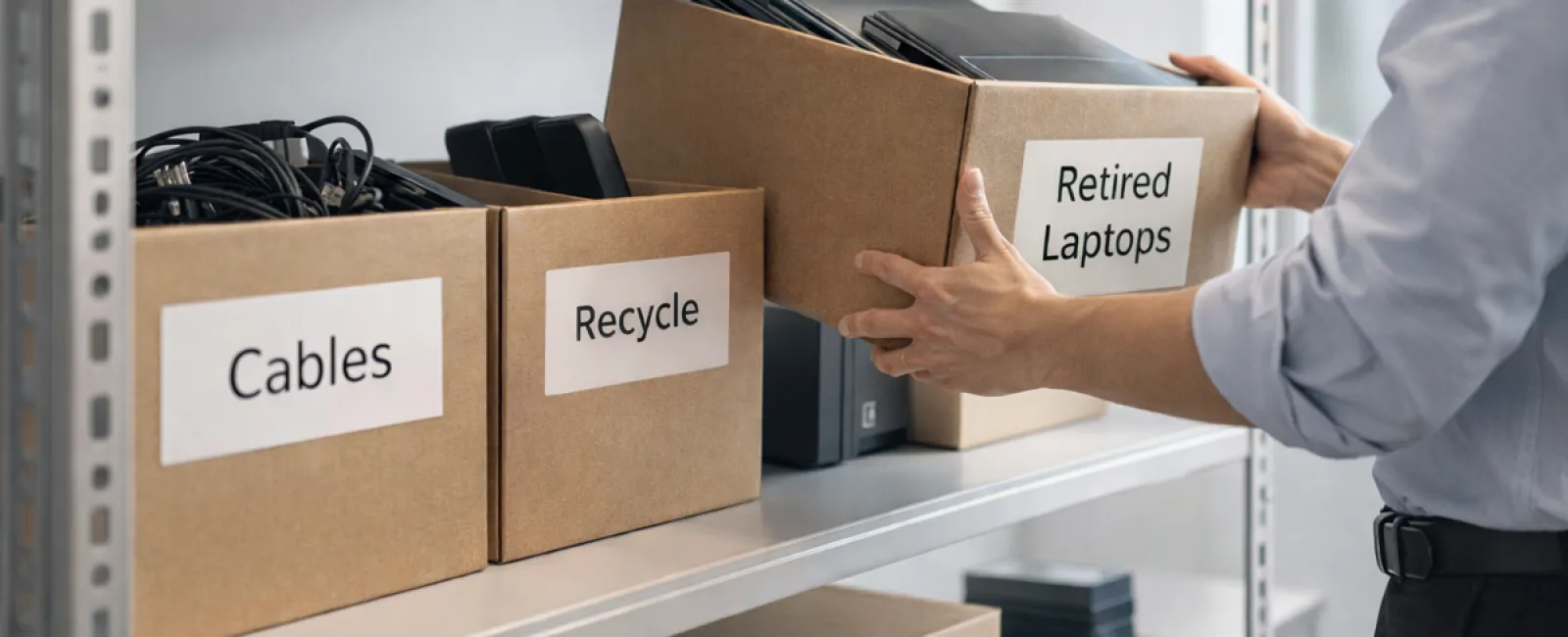
Old laptops. Retired printers. Backup drives from three upgrades ago.
Boxes of cables nobody wants to throw away just in case.
Every business accumulates this stuff. The question is not whether you
have it. The question is whether you have a plan for what happens next.
Technology Has a Lifecycle, Not Just a Purchase Date
When you buy new equipment, there is usually a clear reason. It is
faster, more secure, more capable, or it supports growth.
Most businesses plan how they buy technology. Fewer plan how they retire
it.
When a device gets replaced, it often gets set aside. Eventually someone
decides to clear the space. That is completely normal. What is less common is
treating the retirement of technology with the same intention as the purchase.
Old equipment still has usable value, recyclable components, and
sometimes stored data or access credentials. And if it is just sitting around
taking up space and attention, it can create operational drag you do not need.
Spring is a natural time to step back and ask: What is still serving us,
and what is just taking up space?
A Practical Four-Step Framework for Cleaning Up Your Tech
If you want this to be more than a "we should probably"
conversation, here is a simple approach to move through it.
Step 1: Take Inventory
What are you actually retiring? Laptops, phones, printers, network gear,
external drives? You cannot manage what you have not identified, and a quick
walkthrough often turns up more than expected.
Step 2: Decide the Destination
Every device typically falls into one of three categories: reuse
(internally or through donation), recycle (through a certified e-waste
program), or destroy (when data sensitivity requires it). The goal is making
that decision intentionally rather than letting hardware drift into storage
indefinitely.
Step 3: Prepare the Device Properly
This is where a little discipline goes a long way.
If a device is being reused or donated, remove it from your device
management systems, revoke user access, and verify that data has been properly
wiped. A quick factory reset is not enough. When you delete files or do a basic
format, the data does not disappear. The computer simply stops keeping track of
where it is stored.
A study by data security firm Blancco found that 42% of resold drives
purchased on eBay still contained sensitive data, including personal tax
records and passport information, even though the sellers believed the drives
had been wiped. A certified data erasure tool overwrites every sector and
provides a verification report.
If a device is being recycled, use a certified e-waste provider rather
than the curb or a general dumpster. One thing worth knowing: Best Buy's
recycling program is for household residents only, not businesses. For
commercial equipment, look for a certified IT asset disposition (ITAD) provider
or business-focused e-waste recycler with e-Stewards or R2 certification. Both
have searchable directories at e-stewards.org and sustainableelectronics.org.
Your IT provider can typically coordinate this as well.
If equipment needs to be destroyed, use certified wiping or physical
drive destruction such as professional shredding or degaussing, and keep a
record that includes the device serial number, method used, date, and who
handled it.
This is not about being overly cautious. It is about closing the loop the
right way.
Step 4: Document and Move On
Once equipment leaves your building, you should know where it went, how
it was handled, and that access has been fully removed. A simple record takes
the guesswork out of it later.
The Devices That Often Get Overlooked
Laptops usually get attention. These often do not.
Phones and tablets may still contain email access, contact lists, or authentication apps. A
factory reset handles most of it, but for business devices a certified mobile
wipe tool is more thorough. Apple, Samsung, and most major manufacturers also
offer trade-in programs for older devices, so you may be able to put that
credit toward new equipment.
Printers and copiers frequently include internal hard drives that store copies of everything
they have ever printed, scanned, copied, or faxed. If you are returning a
leased copier, confirm in writing that the hard drive will be wiped or removed
before the machine is redeployed elsewhere.
Batteries are classified as potentially hazardous waste by the EPA, and in several
states including California, New York, and Minnesota, throwing rechargeable
batteries in the regular trash is illegal for businesses. Remove them from
devices when possible, tape the terminals to prevent short circuits, and bring
them to a certified drop-off. Call2Recycle.org has a searchable location map,
and Staples, Home Depot, and Lowe's accept rechargeable batteries at most
locations.
External drives and retired servers tend to live in closets longer than planned. They are
not automatically a problem, but they deserve the same retirement process as
everything else.
A Quick Word on Recycling
Electronics should not end up in landfills. The world generates over 62
million metric tons of e-waste every year, and only about 22% gets properly
recycled. Batteries, monitors, and circuit boards all belong in certified
recycling streams, and most communities have options available for exactly this
reason.
Handled correctly, retiring technology is operationally clean,
environmentally responsible, and worth mentioning. Customers notice when
businesses handle things thoughtfully without making a big production out of
it.
The Bigger Opportunity
Spring cleaning is not really about getting rid of things. It is about
making space.
Clearing out outdated equipment is one piece of the picture. But while
you are stepping back and evaluating hardware, it is worth asking a bigger
question: Is our technology actually supporting how we want to run this
business?
Hardware comes and goes. Today it is software, systems, automation, and
process design that drive productivity and profitability. Retiring old
equipment properly is good housekeeping. Making sure the rest of your
technology aligns with your goals is what keeps you moving forward.
Where We Come In
If you already have a clear process for retiring equipment, great. That
is exactly how this should feel: simple and routine.
But while you are thinking about replacing old hardware the right way, it
is also a good time to look at the bigger picture. Are your systems
streamlined? Are your tools working together? Is your technology helping you
grow or just keeping the lights on?
If you would like to step back and take a honest look at how your tech
stack, systems, and processes are supporting your productivity and
profitability, we are happy to have that conversation.
No equipment checklist. No hard sell. Just a practical discussion about
how technology can work better for your business.
Call us at 702-970-3472 or book your 10-minute discovery call below.
And if this sparked a thought for another business owner, feel free to
pass it along. Spring cleaning should not stop at closets. It should include
the systems that keep your business running.
Book your 20-minute discovery call here. 15-Minute Discovery Call (Free) |
CHR Creative